
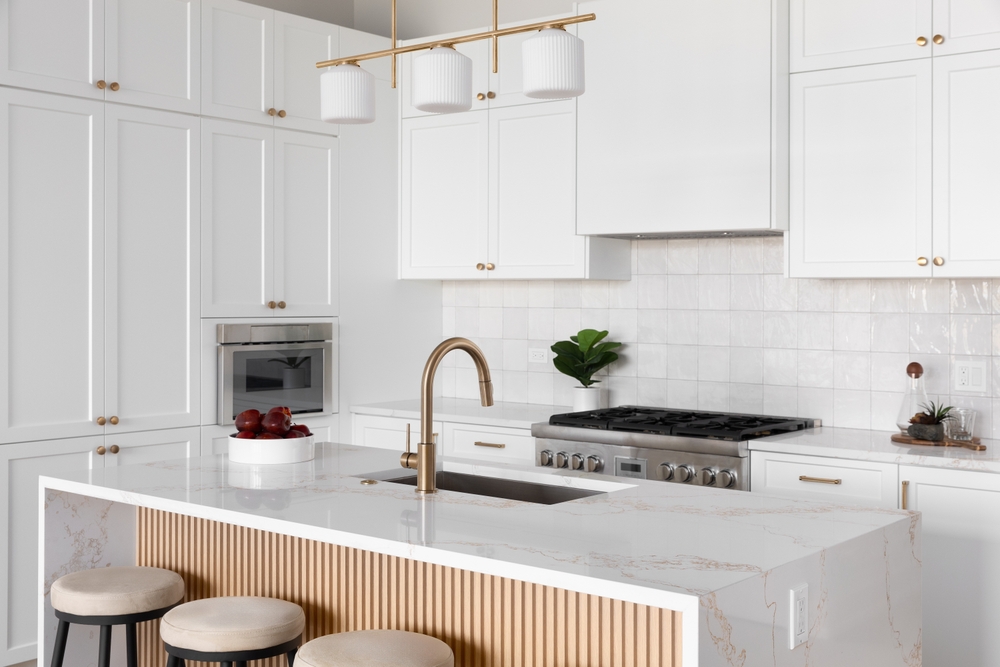
Adding a focal point to your kitchen changes the way you entertain and live. A thoughtfully designed kitchen island doubles as a prep area, a focal piece, and a place for family get-togethers. However, choosing the incorrect size might lead to significant congestion and disrupt the room’s flow. You should decide the exact dimensions of the kitchen island that will match your particular floor layout without taking up too much space.
Creating a focal point in your kitchen transforms how you live and entertain. A well-planned kitchen island serves as a prep space, a focal point, and a gathering spot for family members. However, choosing the wrong size could cause serious traffic jams and interfere with the room’s natural flow.
It takes exact measurements and knowledge of your movement through the space to find the balance. Aisle widths, seating clearance, and the oven and refrigerator’s swing radius should all be taken into consideration. At Driftwood Design, we help you handle the whole process from start to finish.
Assessing Your Available Floor Space
Measure your space before looking at countertop or cabinet styles. Your kitchen’s overall size determines what is physically feasible. To work well, a kitchen island needs a lot of breathing area on all four sides. It is not enough to just place a block of cabinets in the middle and hope for the best.
Measure the room from wall to wall to begin. Make a note of any fixed features that lower the usable square footage, such as radiators, columns, or bump-outs. This baseline figure indicates whether you even have enough square footage overall to support a permanent building. It may not be possible to install a built-in island in a kitchen that is smaller than 13 feet wide.
The “work zones” in your plan must also be taken into account. The kitchen triangle is formed by the route that connects your refrigerator, stove, and sink. This triangle’s leg should not be penetrated by your kitchen island by more than 12 inches. The island is too large or positioned incorrectly if it starts to become a barrier that you must constantly navigate.
Tip: Use painter’s tape or flattened cardboard boxes to mock up the island footprint on your floor. Live with this outline for a few days to see if it disrupts your movement.
The Golden Rules of Clearance
The aisle widths are the most important measurements in kitchen design. On all sides of the island, you must have at least 36 inches of clearance. This enables one person to open drawers and move about comfortably without running into the wall behind them. In order to optimize the island’s footprint in a typical kitchen, it is often needed to adhere to this minimum.
However, 36 inches is tight for a multi-cook household. Increase the work aisle to 42 inches if you have the room. 48 inches is the perfect width for the aisle in places where two persons might cook simultaneously. When the stove is occupied or the dishwasher is open, these clearances avoid traffic bottlenecks. When planning kitchen design in Middletown Township, NJ, following the golden rules of clearance is essential, as proper aisle widths help your island function comfortably, whether one person is cooking or multiple people are sharing the space.
Key Takeaways:
- Maintain a minimum clearance of 36 inches on all sides of the island.
- Increase aisle width to 42-48 inches for multiple cooks.
- Do not obstruct the main work triangle with the island structure.
Standard Kitchen Island Dimensions
Industry standards are in place for a purpose, even if bespoke cabinetry can be any dimension. Typically, a kitchen island measures 80 inches in length and 40 inches in depth. This size accommodates seats and appliances while offering sufficient counter space for prep work. Many properties, nevertheless, don’t precisely fulfill these requirements.
The typical height of a kitchen island is 36 inches, which is the same as your perimeter counters. The ideal counter height for food preparation is this one. You would construct a second tier that is 42 inches tall if you wanted a raised bar for sitting. While dividing the flat surface area, this bar height level conceals dirty dishes from the living area.
Another important consideration when determining kitchen island measurements is depth. Base cabinets are typically 24 inches deep. Your overall depth must be at least 36 inches if you include a 12-inch overhang for seating. To keep water from the sink from splashing onto the persons seated across from you, most designers recommend a depth of 42 inches or more.
Minimum and Maximum Limits
For a fixed kitchen island to be practical, it must be at least 4 feet long and 2 feet deep. Generally speaking, anything smaller works better as a butcher block table or moveable cart. An island that is too small is unstable and does not provide a useful surface for labor or storage.
Large islands, on the other hand, may cause problems with material supply and cleaning. You might be looking for two slabs of stone if your kitchen island is longer than ten feet. If not done correctly, seaming quartz or natural stone can appear haphazard. Furthermore, it is challenging for the average person to get deeper than five feet to the center of an island.
Functionality Determines Layout
Your intended use for the space should drive the final kitchen island sizes. If you plan to install a sink or cooktop, you need specific allowances. A sink requires at least 18 inches of counter space on one side and 24 inches on the other. This means that you have space to cook veggies and stack dishes.
When using a cooktop on an island, safety becomes the top priority. If there isn’t any seating, you need at least 9 inches of room behind the burners; if there is, you need 24 inches. This keeps guests from getting splattered by hot grease. In order to accommodate pot handles and ingredients, you also need 12 to 15 inches of landing area on either side of the range.
The island’s dimensions can be more flexible if your only objective is more prep and storage. If the seating overhang is omitted, the depth can be decreased. But bear in mind that a kitchen island devoid of seating frequently functions more as a workstation than a gathering place. Remember the criteria of the electrical code. In order to keep cables from extending across walkways, the majority of building rules require that there be at least one outlet on the island.
Seating Configurations and Space
The specifications for your kitchen island are drastically altered when stools are added. A 24-inch width is required for each individual to sit comfortably without elbow bumps. A kitchen island that can accommodate three people must be at least six feet (72 inches) long. No one will feel comfortable if four individuals are crammed into that area.
For comfort, knee space is equally important. You need 15 inches of clear overhang for a counter that is 36 inches high. It is adequate to have 12 inches of overhang if you select a 42-inch high bar. When this depth is cut, guests are forced to straddle the cabinets or sit sideways, which is inconvenient when eating.
The area behind the stools must also be taken into consideration. A person occupies roughly 24 inches of depth while seated. It takes an additional 24 inches to get by them in traffic. This means that the distance between the island edge and the wall on the seating side must be at least 48 inches.
Calculating Your Perfect Size
Determining the right dimensions involves a process of subtraction. You start with the room size and subtract the required clearances to see what is left. This technique guarantees that the size of your kitchen island will naturally fit the space. For a successful kitchen design wall in Township, NJ, finding the proper dimensions starts by measuring the full room and subtracting the necessary clearances so the island fits comfortably within the space.
How to Calculate Maximum Island Dimensions
- Measure Total Floor Space: Note the entire width and length of the empty floor space where the island will be placed. Measure the perimeter of the cabinets’ fronts rather than their walls. To accommodate for walls that aren’t precisely square, double-check dimensions.
- Subtract Required Walkways: Deduct at least 36 inches for every work aisle and 48 inches for any aisle with seating. If you’re working with a high-traffic zone, deduct 42 to 48 inches.
- Determine Remaining Area: The number remaining is your maximum island size. Compare this to standard cabinet sizes to finalize your design.
Material Limitations and Aesthetics
The size of your island may be constrained by the materials of your countertop, even if your area is enormous. The majority of granite and quartz slabs are little more than 5.5 feet wide by 10 feet long. You will see a seam running across the surface if your design goes beyond these figures. To minimize this visual split, many homeowners would rather make the island somewhat smaller.
You may need to be imaginative while designing tiny kitchens. It’s not necessary for an island to be rectangular. To enhance flow, utilize a curved edge or an L-shape. You may fit a kitchen island into a room that wouldn’t fit a regular rectangle by using these unique shapes.
Solutions for Tight Spaces
Not every house can accommodate a large, permanent structure. A tiny console table or a rolling island are great options for small areas. Without permanently obstructing traffic flow, these alternatives offer an additional counter surface. When your home is full of visitors, you can set it aside with a movable island.
Island galley kitchens are notoriously challenging. A permanent island is probably not feasible if the width of your kitchen is less than 12 feet. A peninsula that is fixed to a wall or an existing counter is frequently a superior option in these kitchen layouts. Although it needs less clearance, it provides advantages comparable to those of a kitchen island.
A tiered island is an additional choice for small floor spaces. You can visibly divide the unit’s bulk by changing the height. This gives you the functionality you require while giving the impression that the kitchen is larger. Just keep in mind that multi-level islands are a little less adaptable for extensive spreading jobs like gift wrapping or baking.
Common Mistakes with Kitchen Islands
People frequently make mistakes that reduce the size of their kitchen islands, even with meticulous planning. Ignoring how appliance doors swing is the most frequent error. When the dishwasher is closed, you may measure the aisle, but when it opens, it might collide with the island cabinets. Every door and drawer should always be completely extended when measuring clearances.
Oversizing the island in open-concept houses is another common mistake. It’s not necessary for the kitchen island to take up half of your large space. Walking around an island that is too large becomes a nuisance. Two smaller kitchen islands are preferable to one large one that causes traffic jams.
Keep in mind that your chairs are normally higher than the counter. Sitting becomes problematic when purchasing barstools for an island that is counter-height. When buying furniture, always make sure the seat and countertop surface are at the same height.
Choosing the Right Kitchen Island Size for Function and Flow
A combination of mathematics and lifestyle analysis goes into selecting the ideal kitchen island size. You have to put the room’s purpose ahead of your need for a huge focal point. Your island will improve your house for many years if you adhere to the clearance zones and precisely estimate your demands. While a badly designed kitchen island only gets in the way, one that is the right size promotes community.
Spend some time measuring twice and marking out the layout on your floor using tape. Move around the room, turn on the appliances, and act as though you’re preparing a meal. The best method to confirm that the measurements of your kitchen island are ideal for your particular house is to do this physical test. The correct fit makes all the difference, whether you go for a large eating bar or a small prep station. If you want expert guidance to get the layout right the first time, contact Driftwood Design today and start planning a kitchen island that truly fits your space and lifestyle.