Many homeowners wonder if it is possible to upgrade their kitchen storage without discarding their current stone or quartz surfaces. While the process demands careful planning and precise execution, you can successfully install new base units while keeping the countertops you already love. This strategy preserves expensive materials and avoids the cost of a new slab, provided the renovation follows strict structural protocols.
Supporting a heavy slab in mid-air while removing its foundation presents significant technical challenges. A standard stone surface relies entirely on the wooden frames below for its stability. Experts like Driftwood Design LLC emphasize that success depends on a thorough assessment of weight distribution and the installation of temporary structural supports.
Evaluating Material Strength and Condition
Before beginning a project, you must determine if your current surfaces can survive the transition. Natural stone, engineered quartz, and solid surface materials generally withstand this process because of their inherent rigidity. Granite and quartz possess the internal strength necessary to remain stable during a temporary suspension.
Conversely, laminate or tile counters rarely survive the stress of losing their primary support. The particleboard core of a laminate counter bends easily, causing the surface to crack or warp under its own weight. In these cases, a full replacement is usually the only viable option for a successful kitchen renovation.
Weight Distribution and Tensile Strength
A standard granite slab weighs approximately 18 pounds per square foot. This immense weight means any temporary shoring system must carry hundreds of pounds without flexing or shifting. Even a fraction of an inch of movement can cause the stone to crack along natural fault lines. While quartz offers a small buffer against stress fractures due to engineered resins, all heavy surfaces must be treated with extreme caution.
Mechanics of Temporary Support Systems
Removing the foundation of your kitchen workspace requires building an alternative framework. Driftwood Design LLC typically constructs a shoring system using construction-grade lumber and heavy-duty adjustable jacks. This framework bridges the gap between the floor and the underside of the stone, distributing the load continuously while the old boxes are extracted. Builders often attach horizontal beams to the wall studs to create a secure ledge for the back edge of the stone, while steel supports handle the front edge.
Managing Utilities and Fixtures
Suspending a countertop involves more than just managing heavy stone; you must also account for the plumbing and electrical lines hidden within the cabinetry. Sinks are usually mounted directly to the stone, requiring you to disconnect drain pipes and supply lines while keeping the basin attached to the counter. Dishwashers must be pulled completely out of their bays, and power must be shut off at the main breaker to safely extract wiring for island outlets or disposals without severing connections.
Financial and Practical Comparison
While you avoid the cost of a new slab, the specialized labor required for this delicate operation carries a premium price tag. It is essential to weigh these labor costs against the price of a total replacement.
| Factor | Preserving Existing Surfaces | Full Surface Replacement |
| Material Expense | $0 (Reused) | High (New Stone Purchase) |
| Labor Complexity | Extreme (Structural Shoring) | Standard (Direct Install) |
| Risk of Damage | High (Potential Fractures) | Low (New Product Warranty) |
| Design Flexibility | Locked to Current Footprint | High (Can Change Layout) |
| Aesthetic Result | Hybrid (New Base, Old Top) | Uniform (Cohesive Update) |
The Installation Process
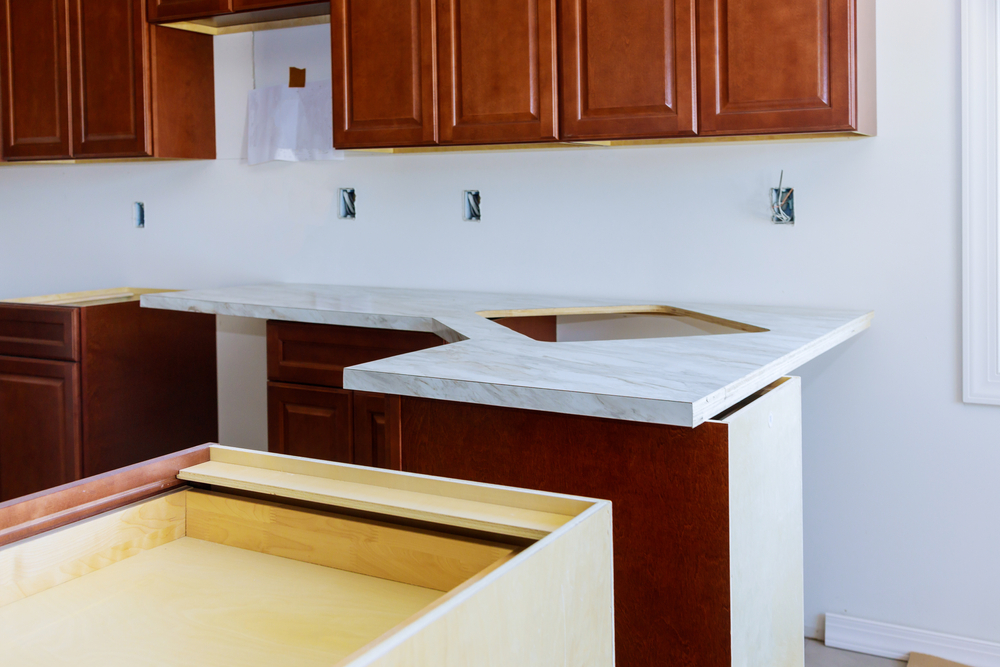
Executing a cabinet swap requires a logical sequence of events. After protecting the flooring with impact-resistant panels, the adhesive bond between the stone and the wood must be broken. Installers carefully slice through the silicone using specialized tools, sometimes applying gentle heat to soften stubborn bonds. Once the old boxes are removed, the new kitchen cabinetry in Sea Girt, NJ is slid into position, leveled with shims, and secured to the wall studs before the stone is lowered onto its new foundation.
Long-Term Maintenance and Structural Integrity
Preserving your original counters during a remodel also requires a look at the long-term health of the stone. Once the new cabinets are secured, it is the perfect time to inspect the stone for any micro-fissures or dull spots that may have developed over years of use. Sealing the stone immediately after the new cabinets are installed helps prevent moisture from the installation process from penetrating the surface. Guaranteeing that the new cabinet boxes provide a perfectly level plane is vital to prevent pressure points that lead to structural failure later.
Enhancing the Value of Your Professional Remodel
Beyond the physical labor, successfully retaining your surfaces requires a deep understanding of house settling and floor joist capacity. When you remove heavy cabinets, the floor may slightly rebound, shifting the alignment of your temporary supports. A professional team monitors these minute changes to prevent the stone from experiencing uneven tension. This level of precision is what separates a successful renovation from a catastrophic failure that could result in the total loss of your countertop investment.
Furthermore, this approach allows you to reallocate your budget toward higher-end cabinet features, such as soft-close dovetail drawers or custom organizational inserts, rather than spending those funds on new stone. By focusing on the structural foundation first, you create a kitchen that is not only aesthetically refreshed but also mechanically sound for decades to come. Professional installers can even adjust the footprint slightly to fix previous installation errors.
When a Complete Replacement is Preferable
There are specific scenarios where attempting to save old surfaces creates more problems than it solves. If your goal is a fresh kitchen design in Bay Head, NJ, a full replacement is often necessary. Existing slabs are cut to a specific footprint; if you wish to move a sink, add a larger dishwasher, or change the shape of an island, the old stone will not align with the new configuration. Upgrading to high-end cabinetry might also make dated countertops look out of place. Consulting with Driftwood Design LLC allows you to determine if the cost of preservation provides true value.
Conclusion
Upgrading the units beneath your countertops is a viable way to refresh your home, provided you prioritize structural integrity. By understanding the mechanics of weight distribution and utility management, you can avoid the physical and financial risks associated with heavy stone. Whether you choose to preserve your premium materials or opt for a total replacement, professional guidance is the key to a safe and beautiful kitchen transformation. For expert assistance with your kitchen remodel and cabinet installation, contact us today.